When Things Go Wrong:
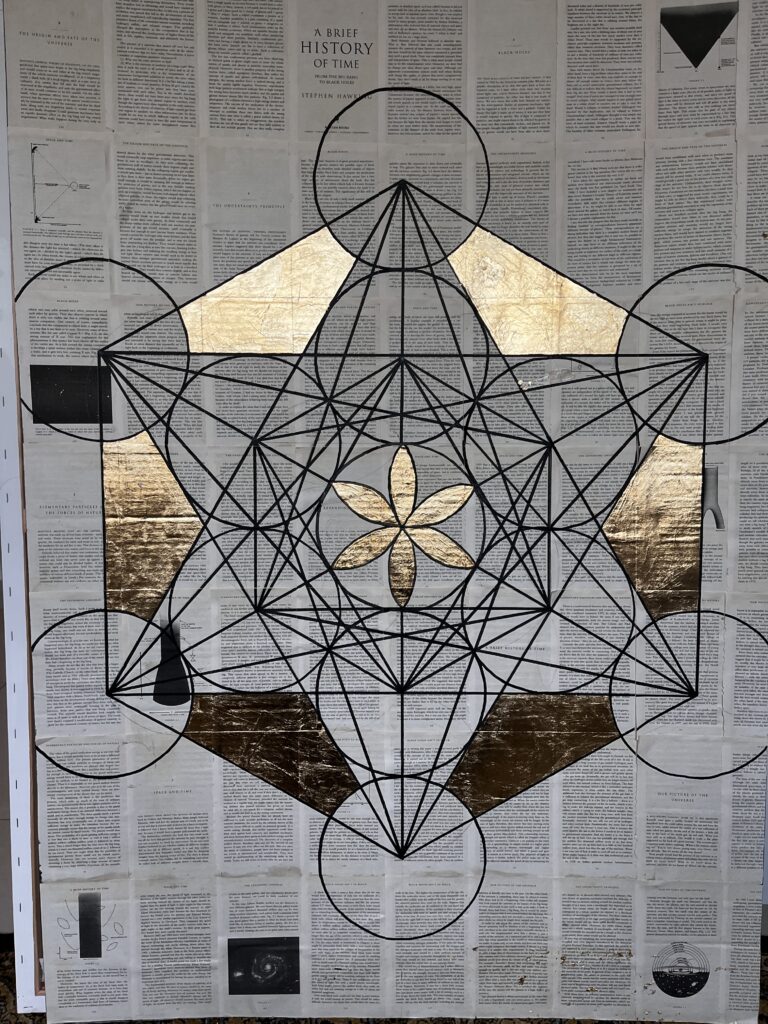
Some art pieces fail abysmally. But I guess that’s part of the point of the Practice-based research process.
This piece entitled ‘Metatron’s Cube’ forms part of my investigations into whether, when using elemental materials* and/or when making art around the theme of interconnectedness, this makes the artist feel more connected.
I started out priming a large piece of corrugated cardboard, then gluing pages torn from Stephen Hawking’s book entitled ‘A Brief History of Time’ to form the background. I was discerning as to which sections of the book I used, attempting to balance between full pages, pages with diagrams, and pages of chapter beginnings.
Thereafter, I took myself through the process of drawing an oversized Metatron’s Cube – a familiar image in Sacred Geometry which holds all the shapes of the Platonic solids – the building blocks of all physical matter.
Why Metatron’s Cube?
Wang, C (2023) “Metatron’s Cube is often seen as a symbol of balance, harmony, and the interconnectedness of all things. It is considered a powerful symbol in sacred geometry, representing the underlying structure and order of the universe.”
Wang, C (2023): “The Platonic Solids are considered the basic building blocks of the universe, representing its elements and structures. Metatron’s Cube symbolizes the order, harmony, and interconnectedness of everything by including these shapes.
Having the Platonic Solids in Metatron’s Cube tells us that different elemental energies can work together and create change and growth. It shows that sacred geometry helps us understand the complex patterns of the universe and the deep meaning behind them.”
I’ve been fascinated with this symbol for decades and have drawn it on many occasions. The drawing of metatron’s cube is a lengthy process of measurements, angles, calculations and use of an oversized protractor and ruler. In the past when I’ve drawn it, I’ve found it to be a highly engaging, almost meditative experience.
Not so when drawing an oversized complex geometric diagram over paper that already has text on it, which only serves to add complexity to an already complex task.

My In Situ Journalling notes, are transcribed here:
Drawing Metatron’s Cube at scale was not the interconnected zen-like experience I had anticipated. Despite having drawn it countless times over the years, and having thoroughly enjoyed the challenge each time (it takes over an hour to draw it at A4 size), it was physically taxing to draw at scale.
I am not able to draw up to an easel because protractors work successfully when gravity is on your side! So it’s on the floor. I had begun by simply following the YouTube video instructional, but found myself getting lost in all the circles. So now I’m taking to drawing it smaller on paper and after each phase of putting it on paper, I then go to the floor to draw that phase on the larger piece.
The cardboard I’m working on (reuse-recycle-repurpose) has warped as it evidently doesn’t like being slathered in gesso (which also stank up my studio for the last 3 days while it dried).
Thus far, I can’t say I’m feeling any types of feelings of interconnectedness or entanglement. Even after getting the image down with pencil, then to the rewarding part of painting over the lines in acrylic and following up with playing with negative space by using gold leaf, I am not very happy with the piece so far.
I’ll leave it to percolate in my studio for some time and hope that some more inspiration hits, but at the same time I’m happy to have something with which to possibly experiment further.
An interesting and Unexpected Final Observation:
It is interesting to note the difference in experience between the investigation that I did with Clay Sculpture, as opposed to this paper-based drawing exercise. It is not yet possible for me to decipher where the difference in the experience could have resulted from, but these are some initial thoughts/ideas which could possibly be expanded on further down the line or in further research:
- Working with a very pure elemental material such as clay, vs working with some non-elemental materials (gesso, book pages, etc.)
- Sculpting, which, viscerally, feels more ‘natural’ than cutting, sticking, drawing, and hopping up and down between desk and floor, vs other types of art practice. (I am reminded of my first ceramic class at school when I was 14 – our teacher started the class by asking us to eat a small piece of the clay, to taste it, to comment on it’s texture, to rub it on our skin and to talk about how it felt and smelled, reminding us of it’s purity and that it was directly from the earth.)
- My mood on each of the days of making.
- The subject matter that I was making – the difference between exploring an object (my ‘creature’) vs making a pre-defined drawing of Metatron’s Cube that has very strict rules/measurements/methods in order to succeed.
______________________________________________________________________________
*elemental materials is the term that I have coined to mean any art materials that contain elements from the periodic table that are also found in humans (mammals and other creatures too), plants, the ocean, the earth’s crust, the atmosphere and the cosmos. In essence, elemental materials are those art materials that are connected to us and the universe because they are made of the same basic building blocks.
References:
- Wang, C (2023) Metatron’s Cube Meaning: A Powerful Symbol of Sacred Geometry. Buddha and Karma Website: https://buddhaandkarma.com/blogs/guide/metatrons-cube-meaning
 Debbie New