It was great to watch this pre-recorded talk by Dr Tom Palin. Whilst his work, style and subject of enquiry are nowhere near mine, what I loved to see was how his work fits together.
Initially, looking at his small block paintings one by one, they didn’t make too much sense to me: though Tom has explained what he was investigating with his paintings – and I guess as with most of our MA investigations, the focal point is not actually the final finished artefact, but rather the focus is on what the investigative findings are during and after the making of the artefact – I battled to reconcile his theory with his practice.
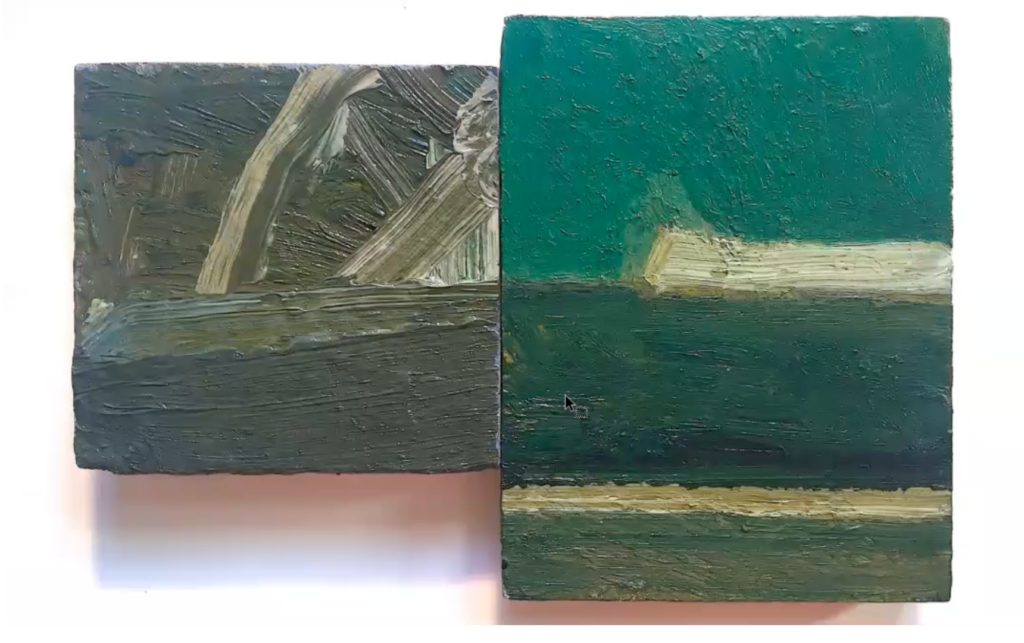
However, as soon as he showed images of the body of work, hung together for an exhibition, it all came together and made sense:
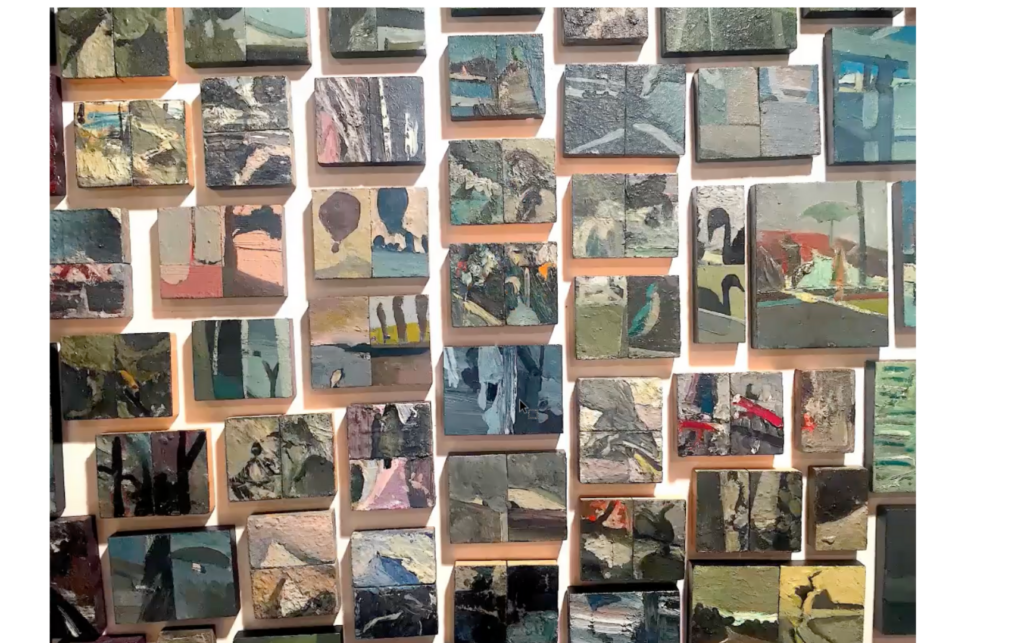
My main takeaway from the talk was that even though many artwork investigations require of the artist to immerse themselves into the piece and to surrender themselves completely to the process, it’s as important to take a step back and think about:
- how and where the current piece fits into the research
- how it fits with other pieces that have been made
- whether there are other pieces that need to be added or ‘bolted on’ in order to make the investigation or message more complete
- how the pieces will come together to form a body of work
- how that body of work can be coherently displayed in a way that is ‘consumable’ for it’s intended audience.
The notes below were copied from the OCA Week 2 page – I wanted to have a copy of them here for easy reference.
Biography and Statement: Dr Tom Palin
Tom Palin is a painter, writer, and teacher, born in Birkenhead. He studied at Liverpool John Moores University, 1993-96, and The University of Manchester, 2004-06. In 2018 he completed his PhD in Painting at The Royal College of Art. His thesis was titled: “The Condition of Painting: Reconsidering Medium Specificity”. Tom has exhibited widely, in group and solo shows, and has been the recipient of: The Royal Academy’s British Institution Award, RA 2015, First Prize in The Wirral Open, Williamson 2011, First Prize (shared) Alumni: Graduates of Liverpool Art School Open, University of Liverpool 2005, The Gilchrist-Fisher Award, Rebecca Hossack 2004, The Emerson Group Award, MAFA 2002, and The Hunting Young Artist of the Year Award, RCA 2000. He was shortlisted for The Marmite Prize for Painting Prize IV, in 2013.
Tom taught at Leeds Arts University for many years, and he currently teaches painting at Edinburgh College of Art, The Open College of the Arts, and Turps Banana. He has written on abstract painting, on the legacies of formalism, and on the white paintings of Maurice Utrillo.
In this weeks lecture, Tom will introduce his work and discuss both his formative influences and his approach to making painting. Tom writes:
“I am interested in the relationship between the paint-aspect and the picture-aspect of a painting. By this I mean that, seen in a particular light, a painting’s picture is ‘there’ and its object is object ‘here’. This here and there – the push and pull of picture and material of painting – serves to constitute a painting’s being: how it is permitted to function, irrespective of its mode of execution, manner or genre. The picture of a painting cannot, therefore, be peeled away from its object’s surface, nor the tangibility of its stuff disentangled from its odd otherness. To Philip Guston, we are image-makers and image-ridden. Yet in painting, the means by which an image takes shape, the material out of which it is fashioned, and the discrete form of its fashioning, are bound to the language of representation: to the world of stories, and of telling. As images, the painted works serve as glimpses of that which has been seen, remembered, or even imagined, then reconstituted through the various and often messy material processes of painting. The small scale permits me to touch and see, and to feel close to what it is that inhabits my space. In its nearness, painting becomes more akin to a seductive surface wherein things simply show up and resonate in proximity to other things.”
 Debbie New