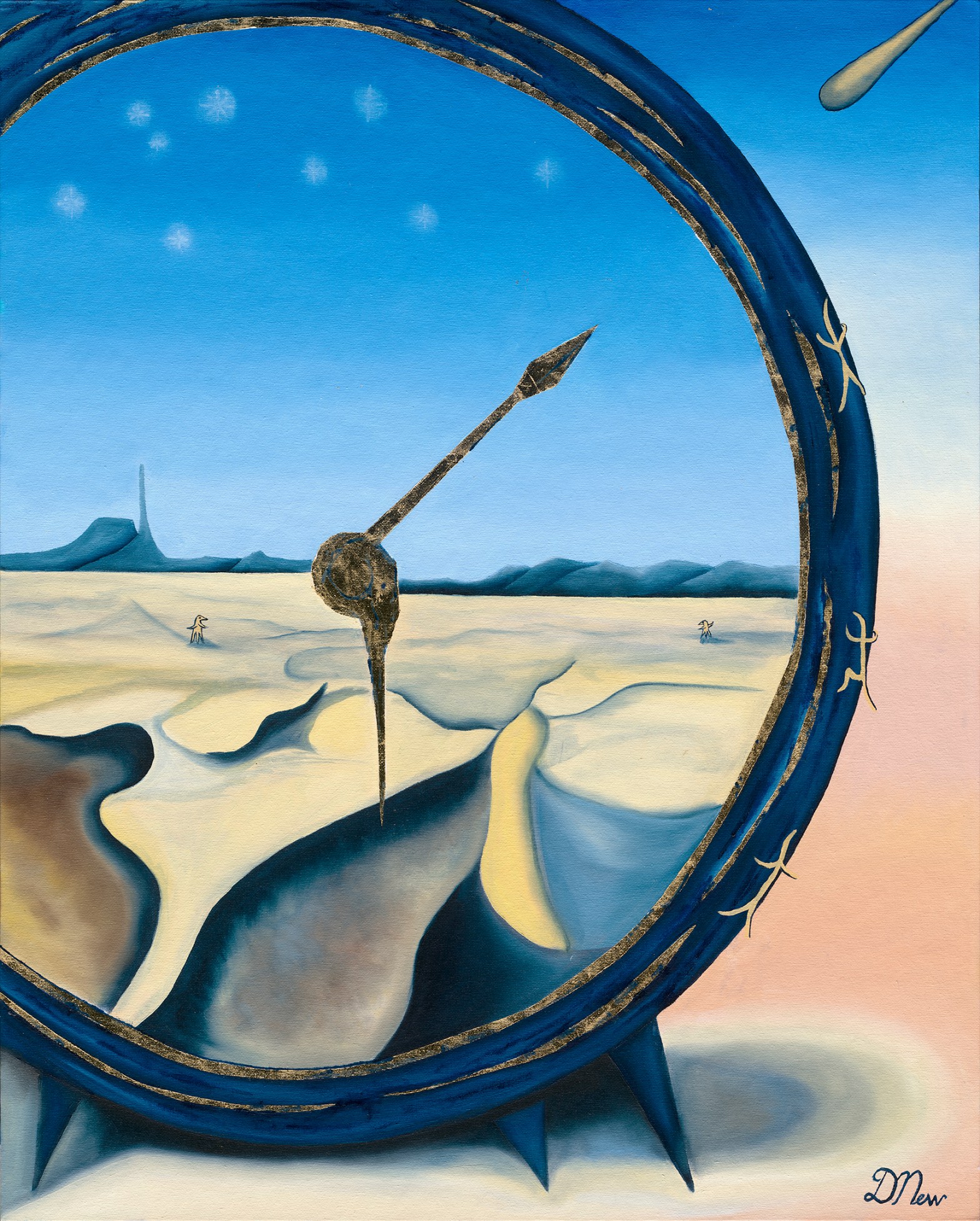
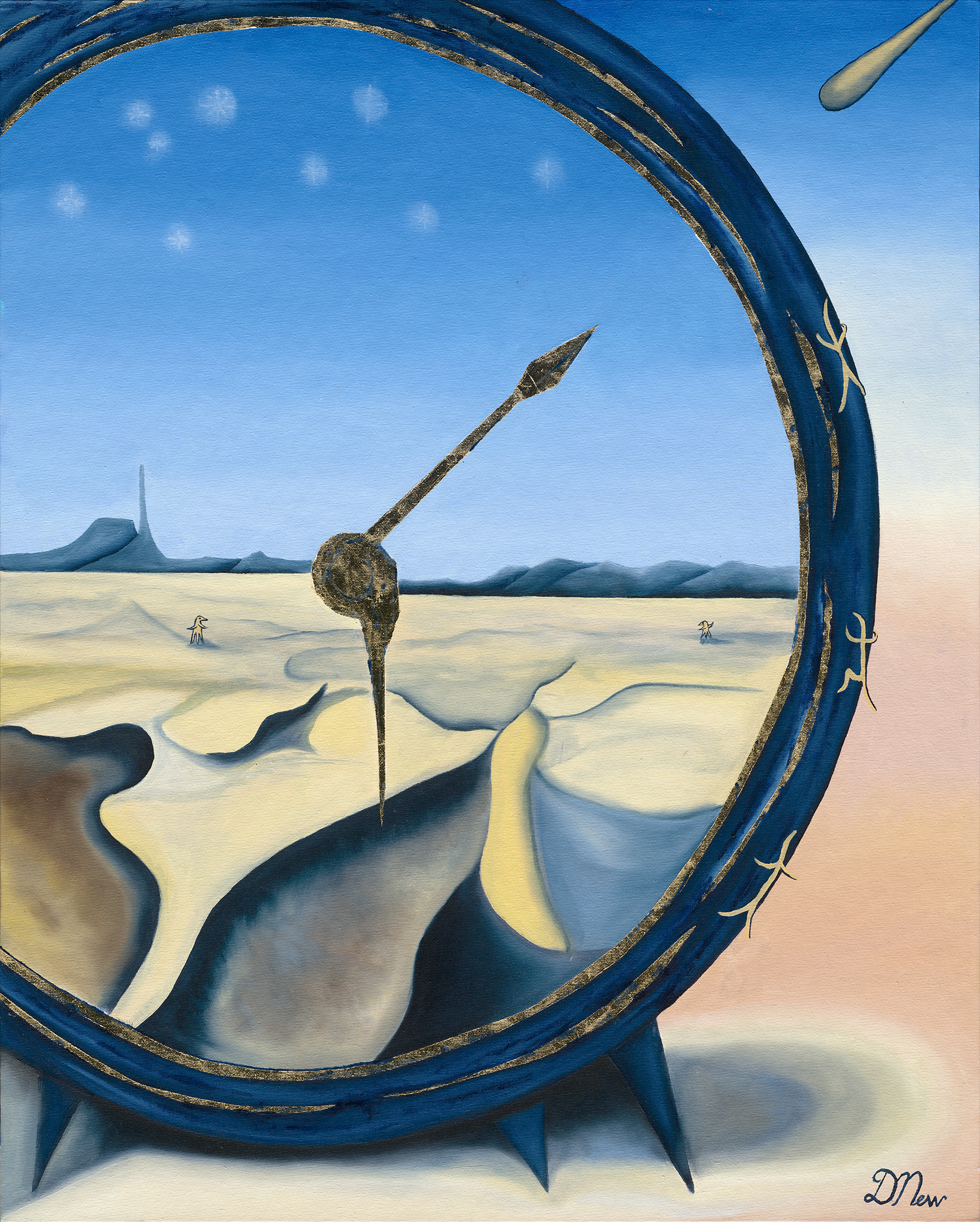
WIP: “Deep Time” Oil Painting 70cm x 60cm
I believe time to be nothing other than an extremely unfortunate social construct. This is one of the conclusions I drew during one of my meditative journeying sessions as part of my practice-based research for my MA degree.
Whilst I understand that modern-day humans cannot function without it, I can’t help but feel that it’s contributed towards our undoing.
Given that my research has taken me into investigating the History of the Universe, pondering on deep time, and what it really means, is almost unfathomable. What does 13.8 billion years mean? What does it look like? And that is just the estimated measurement of time between the Big Bang and now. What about the time before Big Bang? What about infinite time, and infinity in general? If, in universal terms, time is infinite – has no beginning and no end – does time even exist? I don’t believe it does. It is merely a construct made by humans in order to mark the passing of time in an attempt to try to ascribe meaning. And whilst the marking of time has been a way that humans can attribute important events or happenings to a specific time, it has also made us miserable. And regardless of our hustle-culture, regardless of us racing around to get things done on time, every other creature and non-creature on earth pays time no heed.
All the other creatures and non-creatures (such as plants, tides, seasons), exist to a more natural rhythm. The birds don’t care what time of day it is when they fly past. It doesn’t matter to the butterfly whether it’s Wednesday or Sunday. The chimpanzees don’t celebrate birthdays, and the sharks don’t care about the train timetable. And as humans, if we’re lucky enough to make 100 years, what is 100 years on a timeline of 13.8 billion years?
We’ve constructed time with the idea of making order out of chaos, but what we’ve done instead is create misery and madness, whilst the rest of the beings, non beings, stars, moons, suns and meteors carry on in their perpetual cycles of life and death, unconcerned about what year it is on earth.
Besides, the passing of human species time is only relative to our specific planet, and its specific position in relation to our specific Sun in our specific Milky Way Galaxy. Time as we know it, would look different from each and every planet or star in our Milky Way because each planet spins at a different speed to what earth does, and would therefore experience night and day at different intervals.
How serendipitous then, to have stumbled upon Mitch Albom’s book entitled The Time Keeper. The book starts out at a time before time had been invented. One character, Dor, has a penchant for counting. He ascribes names (numbers) to each of his fingers, and “soon he was counting anything he could.”
Some glorious quotes from the book that resonate:
“And on this early page of man’s story, one different child can change the world.” (pp 8)
“Try to imagine a life without timekeeping. You probably can’t. You know the month, the year, the day of the week. There is a clock on your wall or the dashboard of your car. You have a schedule, a calendar, a time for dinner or a movie. Yet all around you, timekeeping is ignored. Birds are not late. A dog does not check its watch. Deer to not fret over passing birthdays. Man alone measures time. Man alone chimes the hours. And, because of this, man alone suffers a paralysing fear that no other creature endures. A fear of time running out.”
And most of Chapter 17:
“It is hard to say how long Dor cried. When he finally lifted his gaze, he saw a figure sitting in front of him.”…
“Is it power that you seek?” the old man asked. …
“I seek,” Dor whispered, “only to stop the sun and the moon.”
“Ah,” the old man said. “Is that not power?”
“Is this death?”
“You were spared from death.”
“To die here instead?”
“No. In this cave, you will not age a moment.”
Dor looked away, ashamed. “I deserve no such gift.”
“It is not a gift.”
He rose and held his staff before him.
“You began something in your days on Earth. Something that will change all who come after you.” Dor shook his head. “You are mistaken. I am a small and shunned person.” “Man rarely knows his own power,” the old man said. …
“Soon man will count all his days, and then smaller segments of the day, and then smaller still – until the counting consumes him, and the wonder of the world he has been given is lost.”
The old man narrowed his gaze. “Why did you measure the days and nights?” Dor looked away “To know,” he answered. “To know?” “Yes.” “And what do you know…” the old man asked “about time?”….
The old man held out a bony finger, then made a swirling motion. The stains from Dor’s tears gathered together, forming a pool of blue on the rocky floor. “Learn what you do not know,” the old man said. “Understand the consequences of counting the moments.” “How?” Dor asked. “By listening to the misery it creates.”
“Please, let me die. I have no wish to go on.” The old man rose. “The length of your days does not belong to you. You will learn that as well.”
 Debbie New