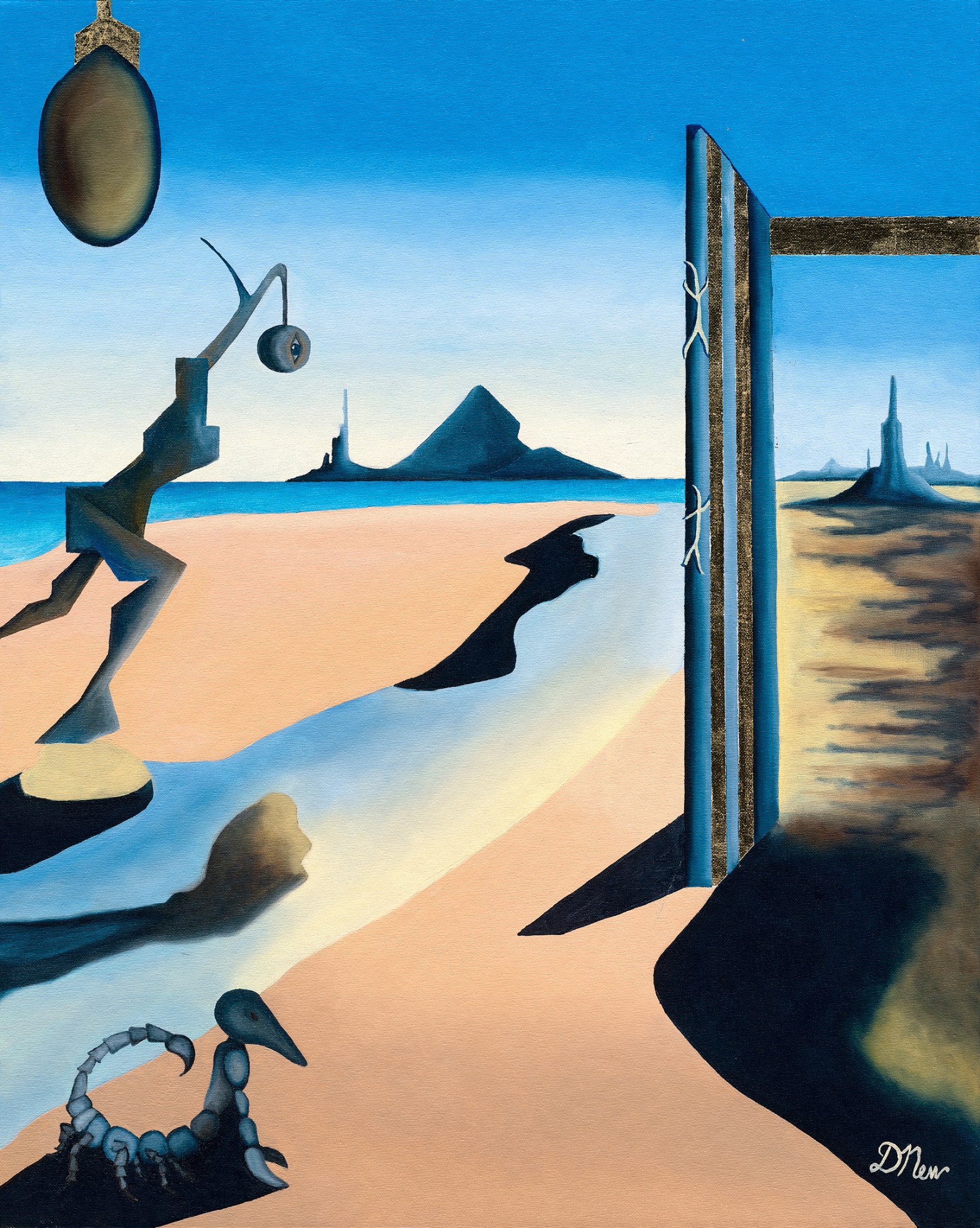
This presentation is a progress presentation for a Crit Session for comment/crit from our cohort. Since my practice-based research is taking me down a path of meditating and making, one becoming entangled with the other, I wondered whether I could take my audience on this journey with me, and so decided to use this presentation to test out one of my methods on my cohort mates.
Video Credit: Video and voice-over created by Debbie New | Royalty-free Stock images and stock music provided via Canva Premium.
Furthermore, herewith a related video about a meditative practice method I have created called “Channelling Stardust” and how it is impacting my recent art making.
Alongside my practice of meditating, channelling stardust and making art, I am journalling: one set of journal entries captures wisdom that I am receiving through my meditative practice. The other set of journal entries captures observations and/or notes that I capture during, before or after the making experience. Sometimes these observations are more esoteric in nature, detailing feelings that arise during the making; other times the observations are of a more materials-investigation nature, detailing ideas or my thinking behind what I am busy making.
For this video, I documented the process in my observations journal entitled: Observations during practice-based research investigations_ Journal Entries.
Herewith the journal entries (the line separators denote different entries on different days):
Journal Entries by artwork:
Title: A Meditative Journey
Medium: Immersive Experience Video
Investigations: Making about Stardust; Meditative Journeying for an audience
Journal Notes around and during the making:
During a recent one-to-one Tutorial with Caroline, we were discussing my meditative journeying and how the practise had morphed and deepened over time and become part of my practice and research. She asked me whether I had thought about the fact that I could keep this part of my art-making to myself, or I could think about ways to share it with an audience. She’d said the choice was mine to make, but that it was definitely something worth thinking about, because the meditation was such an integral part of my art.
It was this conversation that got me thinking about documenting me meditative journeying practice. It was not an easy thing to write down, like catching a falling star or pinning a wave to the sand. The Meditation was something that I’d intuitively felt and followed, not something that even had words attached to it.
I opened a document and began to attempt to write the step-by-step process that I would take myself to. As a part-two to the journey, I also wrote down the part where I channell with stardust onto a piece of art. I had at least had a fair amount of practice writing video scripts, since many of my presentations I have presented as pre-recorded videos.
Once the script was written, I edited it into numbered step-by-step instructions. I read these into a timer to see how long it would take to narrate the script and was pleased to find that it was under 5 minutes. I immediately took to Canva to create a video using the royalty-free stock footage on there. I spent time practising the script, the breathing, the timing, the cadence of my voice. Once upon a lifetime ago, I was a newsreader on a radio station, so my voice can tend to be rather ‘newsy’ if I’m not mindful. I really struggled to slow my voice down, to keep the cadence calm and even. To this day, the sound of my own voice sounds like nails down a chalkboard for me, but I soldiered on, desperate to see the end result of a guided meditation video.
It took a few takes, but I eventually managed to record the script satisfactorily. I pulled the sound file into Canva, listened through their stock music snippets until I found one that I felt was fitting, and added it, applying fade in and fade out effects.
I was really happy with the final outcome, but unsure as to whether the piece was truly capable to taking an audience to the place that I am taking to during my meditative journeying. Only one way to find out.
________________________
A week or so later, we were scheduled to give a 5 minute progress presentation to our MA cohort. The brief was to share not only our practise, but to also show what we were reading, and to touch on how that reading was informing our making, as well as to discuss audiencing… a tall order for a limit of 5 minutes. I decided to take a risk, and to present this meditation video alongside one of the paintings that I was currently working on where I was using meditation as part of my practice. I knew it was a risk: the video would take up 4 of the 5 minute presentation time, so I would not have a lot more time to talk about audiencing and reading. I worried that I might risk being marked down for not sticking to the brief, but decided to take a leap of faith as I needed to start getting my video ‘out there’ to see people’s response to it.
By the time presentation day came, I was having panic attacks with worry, but calmed myself by reminding myself that the meditative journeying is part of my art practice, and that as such, it being something that I had decided I’d like to share with my audience, that it was acceptable to present it to my cohort. The meditative journeying would become very much a part of how I could ensure that my audience could connect more deeply with my work.
I felt that the video was well received by my cohort. The feedback was positive.
________________________
Next, I shared the video with a couple of friends, one of them being a Yoga and Wellness instructor that regularly hosts guided meditations. Her feedback was really positive too – she said “you totally took me there! I was there, in the cosmos.” It was a wonderful thing to hear. She said that I should consider doing a number of longer meditations, where the listener can meditate quietly for 30 minutes or so. Often guided meditations have sections of voice, but also sections of quiet where the practitioner can be in that meditative space on their own, before being brought back by the instructor. I will consider this for the future.
From an audiencing perspective, I feel that an audience being brought straight into a mediation booth of sorts to be taken on this experience before interacting with my art, will help them to connect more deeply with my art and its message. I am therefore thinking about sound delivery methods, working with my projector to project this video onto a large wall, possibly each user will get a pair of noise-cancelling headphones so that the sound of the video can be heard without any outside distractions. Good quality headphones will make the meditation experience more visceral… as if it is playing inside their head (which it does for me when I am meditating), so will bring them closer to the experience I am having.
With the creation of this video, the artwork has almost become secondary. It is the immersive experience that has come to the fore because I feel that this is the most efficient way to get my message across: to give the audience an immersive experience that will change their view of their place in the world.
________________________
References:
Blasdel, A (2017), A reckoning for our species: the philosopher prophet of the Anthropocene. The Guardian Online. Published 15 June 2017. Accessed 16 January 2024. https://amp.theguardian.com/world/2017/jun/15/timothy-morton-anthropocene-philosopher
Darwin, C. (1859) On the Origin of Species by Means of Natural Selection. London: John Murray.
Gee, Henry (2013) The Accidental Species – Misunderstandings of Human Evolution. The University of Chicago Press, Chicago.
Haraway, D. (2016). Staying with the Trouble: Making Kin in the Chthulucene. Duke University Press.
Hawking, S. (1988). A Brief History of Time: From the Big Bang to Black Holes. Penguin Random House UK.
Lovelock, J. (1979). Gaia: A New Look at Life on Earth. Oxford University Press.
Morton, T. (2010). The Ecological Thought. Cambridge, MA: Harvard University Press.
Naess, A. (2008) The Ecology of Wisdom: Writings by Arne Naess. Berkeley: Counterpoint.
Puig de la Bellacasa, M. (2017). Matters of Care: Speculative Ethics in More Than Human Worlds. University of Minnesota Press.
 Debbie New