Given that I’m doing a lot of work around Stardust, I felt that it’s becoming increasingly important that I am able to talk coherently about what I mean when I say stardust. The word itself unfortunately conjures in many people, ideas of unicorns, fairy-godpersons, and magic.
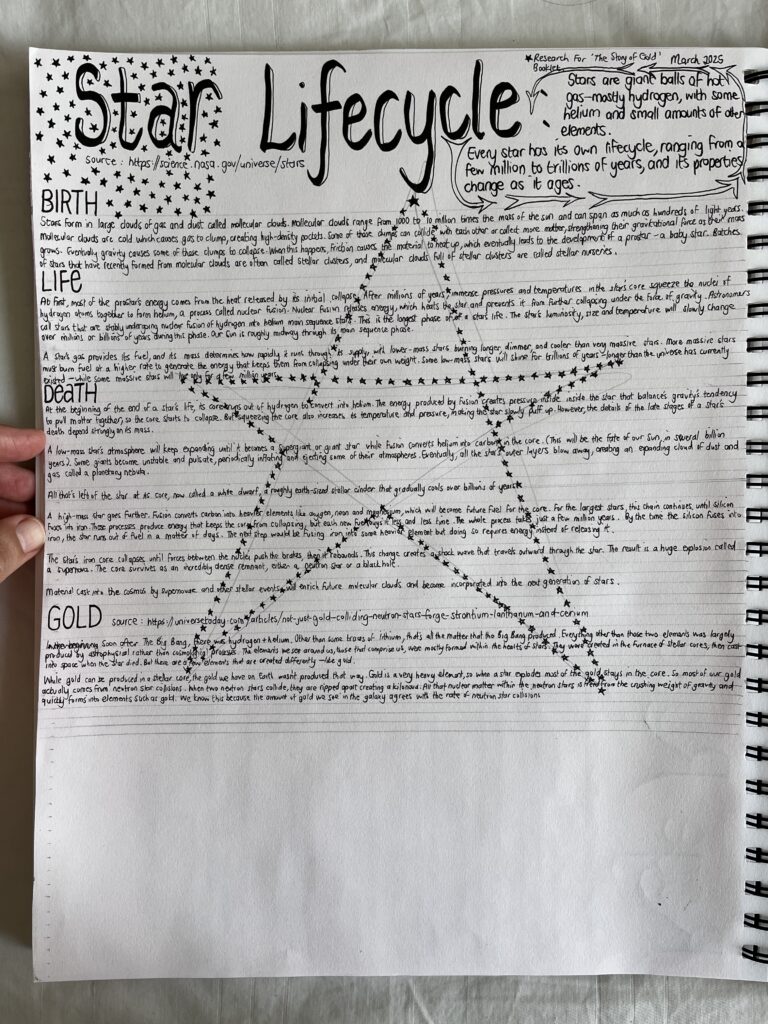
When in fact, stardust – or ‘star stuff’ as some astrophysicists refer it it – is an accurate word in it’s most literal sense: stars, when they die, create all sorts of detritus, including dust, which is burst forth into the cosmos to float around space. This dust is recollected via gravitational forces to become the next generation of stars/suns/planets/moons.
It’s also important to note that different stars die in different ways depending on their type and size. In some instances, their ‘death’ is two fold: perhaps they go supernova and cease to exist, or they go supernova and become a black hole, or a neutron star.
The reason this level of detail matters is because different types of star deaths produce different elements from the Periodic Table. For example, gold comes from two Neutron Stars colliding. “Neutron stars are the remnants of “Neutron stars are formed when a massive star runs out of fuel and collapses. The very central region of the star – the core – collapses, crushing together every proton and electron into a neutron.”
Sources:
Nasa’s Goddard Space Flight Centre’s Website Authors: (2017): “Imagine the Universe.” Nasa Goddard Space Flight Centre Website. Accessed February 2025: https://imagine.gsfc.nasa.gov/science/objects/neutron_stars1.html#:~:text=Neutron%20stars%20are%20formed%20when,and%20electron%20into%20a%20neutron.
 Debbie New