I’ve been doing quite a lot of work on my research and writing of my Contextual Essay, and bringing it all together has put me in a better position to be able to write more coherently about this piece:
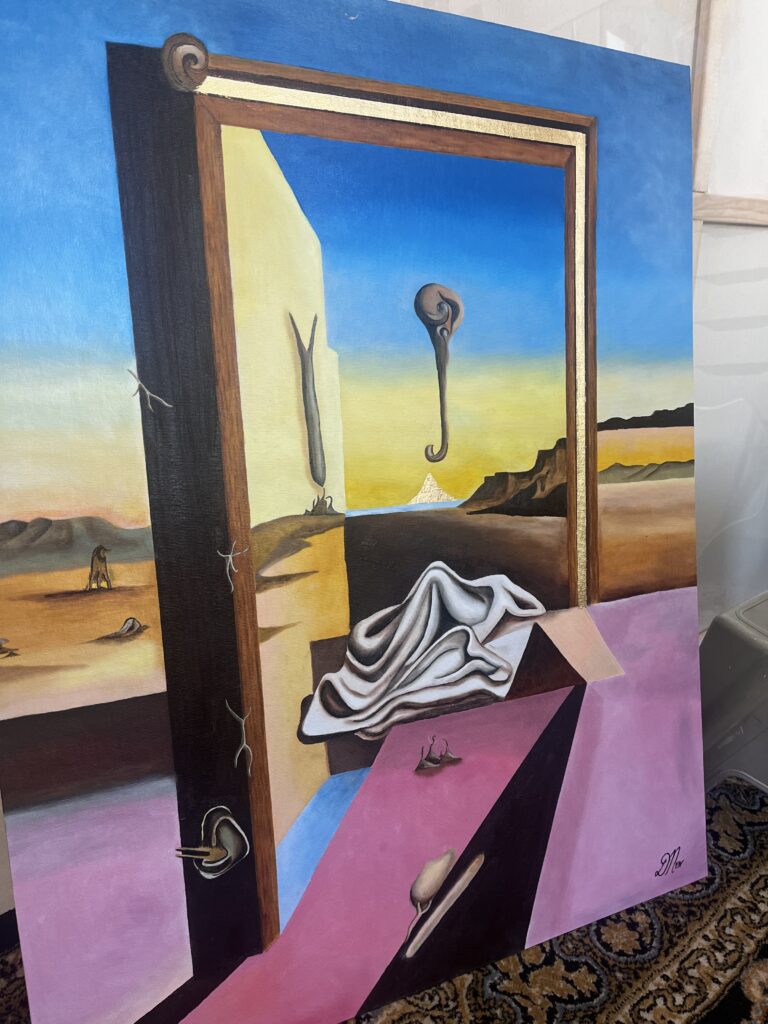
This composition seeks to draw its viewer into the world of the Anthropocene. It is widely argued that this currently dawning epoch, has been created by humans’ negative geological impact on the planet. This impact is to such an extent that in millenia to come, future geologists will find the stories of the demise of the previous epoch.
Blasdel, A (2017) states “Imagine geologists from a future civilisation examining the layers of rock that are in the slow process of forming today, the way we examine the rock strata that formed as the dinosaurs died off. That civilisation will see evidence of our sudden (in geological terms) impact on the planet – including fossilised plastics and layers both of carbon, from burning carbon fuels, and of radioactive particles, from nuclear testing and explosions – just as clearly as we see evidence of the dinosaurs’ rapid demise. We can already observe these layers forming today.”
The idea of an Anthropocene epoch can seem somewhat gloomy and disappointing – it is by the damage that we’ve done that we’ve brought on this new era. However, some philosophers such as argue quite the opposite. Macpherson, A (2018) quoted Schneider: “Enchantment arises, for Schneider, “when we are confronted by circumstances or occurrences so peculiar and so beyond our present understanding as to leave us convinced that, were they to be understood, our image of how the world operates would be radically transformed. To be enchanted is thus . . . [to be] faced with something both real and at the same time uncanny, weird, mysterious, or awesome.”
This painting seeks to depict the idea of the Anthropocene as something that we should become enchanted with and enchanted by, so much so that we wish to know more about it, and we are lured through the doorway that leads to another way of seeing. It is a one way door, and upon entering it, there is no way to return.
Mutant Creatures hover around the outside of the doorway, intrigued, but reluctant to go through, intuiting that moving through the doorway will be the point of no return. The Creatures are inspired by Timothy Morton’s (and indeed Darwin’s) insinuation that we are all indeed mutated cyborgs – a mixture of human and non-human parts.
The Creatures serve to illustrate a world where no one species dominates or is more important than another, mirroring Gee, H (2013) when he states “I shall also show you how to challenge what one reader of a draft of this book has called ‘human exceptionalism’ – the tendency to see human beings as exceptional by virtue of various attributes such as language, technology, or consciousness. There is nothing special about being human, any more than there is anything special about being a guinea peg or a geranium. This insight should allow you to see the world afresh, and marvel at each and every creature as it is, for its innate wonder and uniqueness, not as a way station towards some nebulous, imagined transcendence.”
Morton, T (2016) is also of the school of thought that humans are assemblages of other species: “A human is made up of nonhuman components and is directly related to nonhumans. Lungs are evolved swim bladders. Yet a human is not a fish. A swim bladder, from which lungs derive, is not a lung in waiting. There is nothing remotely lunglike about it. Let alone my bacterial microbiome: there are more bacteria in “me” than “human” components. A lifeform is what Derrida calls arrivant or what I call strange stranger: it is itself yet uncannily not itself at the same time. Contemporary science allows us to think species not as absolutely nonexistent, but as floating, spectral entities that are not directly, constantly present.”
References:
Blasdel, A (2017), A reckoning for our species’: the philosopher prophet of the Anthropocene. The Guardian Online. Published 15 June 2017. Accessed 16 January 2024. https://amp.theguardian.com/world/2017/jun/15/timothy-morton-anthropocene-philosopher
Gee, Henry (2013) The Accidental Species – Misunderstandings of Human Evolution. The University of Chicago Press, Chicago.
Macpherson, A. (2018). Art, Trees, and the Enchantment of the Anthropocene: Caroline Wendling’s White Wood. Environmental Humanities, 10(1), pp 241–256. Published on May 01, 2018. https://read.dukeupress.edu/environmental-humanities/article/10/1/241/134702/Art-Trees-and-the-Enchantment-of-the
Morton, T. (2016). Dark Ecology. Columbia University Press.
 Debbie New