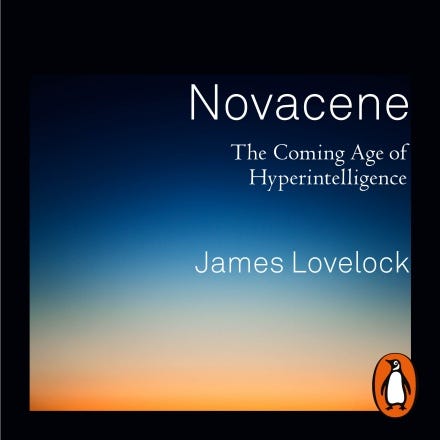
To further my research on interconnectedness and entanglement, I am now reading some of the work of James Lovelock. I’ve just finished reading Novacene: The Coming Age of HyperIntelligence, and have started reading Gaia and We Belong to Gaia by the same author.
What a refreshing, coherent and uplifting read Novacene has been. A far departure from some of the other books I’ve been reading with overly complex and seemingly purposefully inaccessible writing style, I found James Lovelock’s book to be a lot more digestible.
In Novacene, Locklock continually moves between the idea that we have left the Anthropocene epoch and have now moved into the Novacene, and that we are still in the Anthropocene epoch but that it’s days are numbered because the writing of the Novacene is on the wall. I didn’t enjoy this noncommittal style and I was left not understanding which of these two were his own personal stance on the matter.
Context:
Appleyard, B (2019, in the Preface of Novacene) states “Novacene is Jim’s name for a new geological epoch of the planet, an age that succeeds the Anthropocene, which began in 1712 and is already coming to a close. That age was defined by the ways in which humans had attained the ability to alter the geology and ecosystems of the entire planet. The Novacene – which Jim suggests may have already begun – is when our technology moves beyond our control, generating intelligences far greater and, crucially, much faster than our own. How this happens and what is means for us are the story of this book.”
Initial musings about this book:
One of Lovelock’s main ideas is that humans are the chosen species (Anthropocentrism). I do not agree with this – it smacks of organised religion – and whilst admittedly it is mysterious, enchanting and uncanny that humans have evolved in complexity more than any other species, I don’t feel that that means that we are ‘chosen’. However, no sense in throwing the baby out with the bathwater – I’m choosing to agree to disagree because much of what Lovelock writes does resonate with me.
Furthermore, I feel that this book could have been split into two entirely different texts: the first 60% of the book covers the Anthropocene – how we got to where we are now. It reveals a lot of fact and science-backed thought. The remaining 40% of the book contains a lot of conjecture on the part of the author. Lovelock spends this last part of the book teetering between the Novacene having already begun, and the Novacene about to begin, with many suppositions of what Cyborgs/AI would do and think once they ‘take over’. I didn’t love this last 40% – it felt possible, but at the same time fictionalised. I suppose that that is what Science is all about: theorising first, then setting out to prove of disprove.
Books recommended for reading within this book:
- The Anthropic Cosmological Principle by Johan Barrow and Frank Tipler
- The Planet Remade : How Geoengineering Could Change the World by Oliver Morton
I’ve pulled some quotes in case I need to revisit them whilst working on my Contextual Essay.
Conclusions:
All in all, I adored this book for all that was covered in the first 60%, but have to admit that the reason I adored it was because it confirmed what I have intuitively known – that we are all connected. To quote Lovelock in the way that he refers to his Gaia Theory, ” [it] is not easy to explain because it is a concept that arises by intuition from internally held and mostly unconscious information.”
In that respect, the book didn’t challenge me in the same way that other texts have challenged me. Perhaps this interconnectedness is something that all of us know deep down, if we allow ourselves to listen more to our intuition and less to the spoken and thought word.
Quotes copied and pasted here from Novacene by James Lovelock:
My son is mortified to see how much I have highlighted in my copy of this book, but as I said to him, ‘This is my book, my treasure, and I am unlikely to ever want to pass a book like this along.’ Some books are lifelong-keepers and this is one of them.
“Lord Byron’s chilling poem ‘Darkness,’ which ends: ‘The winds were withered in the stagnant air,/And the clouds perish’d; Darkness had no need/ Of aid from them – She was the Universe.’ The poet had glimpsed the cosmic fragility of our existence. Even if another such event did not wipe us out entirely, it could end our civilisations and send us back to the Stone Age.” (page 7)
“A great deal of time may have been wasted during the search for life elsewhere because of the false assumption that the current environment of the Earth is simply a matter of geological happenstance. The truth is that the Earth’s environment has been massively adapted to sustain habitability. It is life that has controlled the heat from the Sun. If you wiped out life entirely from the Earth, it would be impossible to inhabit because it would become far too hot.” (page 11)
“Gaia is not easy to explain because it is a concept that arises by intuition from internally held and mostly unconscious information.” (page 14)
“I have often been criticised for the suggestion – which seems to me to be intuitively true – that Gaia shows that the entire Earth is a single living organism.” (page 14)
“That radiation is the work of Gaia. It is she who pumps excess heat out into space to preserve life and it is for her sake that we must change our ways of thinking.” (page 15)
“The ‘A causes B’ way of thinking is one-dimensional and linear whereas reality is multi-dimentional and non-linear. One has only to think of one’s own life to see how absurd it is to think everything can be explained as a simple linear process of cause and effect. (page 15)
“Before speech and writing appeared, we and all other animals thought intuitively. Imagine a country walk where you come unexpectedly to the edge of a cliff, so high and so steep that one further step would lead to certain death. If this happens, your brain analyses the vision before you and in milliseconds unconsciously recognises the danger. All further forward motion is inhibited. Recent measurements show that this instinctive ration operates within 40 milliseconds of the recognition of danger. It happens well before you are conscious of the cliff. In other words, you are saved by instinct, not by rational conscious thoughts about the danger of falling. Human civilisation took a bad turn when it began to denigrate intuition. Without it, we die. As Einstein said, ‘The intuitive minds is a sacred gift and the rational min is a faithful servant. We have created a society that honours the servant and has forgotten the gift.” (page 19-20)
“But it comes at the cost of valuing conscious thought, debate and argument more highly than instinct. Conscious debate cost Socrates his life.” (page 20)
“We are where we are and we see only what can be seen. But, with intuition, we can know far more than we can see.” (page 22)
“To me it is clear that, however intelligent other creatures may be, the distinguishing feature of human intelligence is that we use it to analyse and speculate about the world and the cosmos and, in the Anthropocene, to make changes of planetary significance.” (page 23)
“Before exploring the Novacene, I need to describe how we reached this point through the workings of the age that preceded it. This is the period in which humans, the chose species, developed technology which enabled them to intervene directly in the processes and structures of the entire planet. It is the age of fire in which we learned to exploit the captured sunlight of the distant past. It is known as the Anthropocene.” (page 30)
“Anthropocene – which has so massively changed the Earth – was driven by market forces. had there been no economic gain from using Newcomen’s steam engine, we might still be back in the world of the seventeenth century. The important feature of Newcomane’s (steam) engine, was its profitability. There mere idea of the engine would not have been enough to ensure its development. Its great significance – for good or ill – was because it was cheaper as a source of work than human or horsepower.” (page 36)
“The Industrial Revolution was an era that simultaneously brought great wealth and great poverty.” (page 37).
“Though the term ‘Industrial Revolution’ is accurate enough, it neither catches the wider significance of the moment, nor does it encompass its full duration. The better name is the Anthropocene because it covers the full 300 years from Newcomen’s installation of his steam pump until now and it captures the great theme of the era: the domination of human power over the entirety of the planet.
The word ‘Anthropocene’ was first used in the early 1980s by Eugene Stoermer, an ecologist who worked on the waters of the Great Lakes that separate Canada from the United States. he coined it to describe the effect of industrial pollution on wildlife of the lakes. It was one more sign that, in the Anthropocene, human activity could have global effects. (page 37-38)
“There are arguments about when this epoch began. Some put it as long ago as the first appearance of Home sapiens, others as recently as the first atomic explosion in 1945. For the moment, it is not even generally accepted as a geological epoch. Many insist we are still in the Holocene, which began about 11,500 years ago when the last ice age ended.” (page 38)
“For me, the key point that justifies the definition of the Anthropocene as a new geological period is the radical change that took place when humans first began to convert stored solar energy into useful work. This makes the Anthropocene the second stage in the planet’s processing of the power of the Sun. In the first stage the chemical process of photosynthesis enabled organisms to convert light into chemical energy. The third stage will be the Novacene, when solar energy is converted into information.” (page 39).
“This is important because, as the photographs from space show so dramatically, Earth is a water planet with nearly three-quarters of its surface covered by oceans. Life on land depends on the supply of certain essential elements such as sulphur, selenium, iodine and others. Just now these are supplied by ocean surface life as gases like dimethyl sulphide and methyl iodide. The loss of this surface life due to the heating of these waters could be catastrophic. Cold water (below 15 degree C) is denser than water warmer than 15 degrees C. Because of this, nutrients in cold water can no longer reach the surface.” (page 60)
“There is a fierce contemporary debate about whether the Anthropocene has been a good or a bad thing. As I have shown, the evidence that it is bad is strong – warming and therefore weakening of the planet, more lethal and destructive warfare, species loss and so on. Much of this can be attributed to the bewilderingly rapid growth of the human population. When Newcomen first made his steam engine the world population was about 700 million; it is now 7.7 billion, more than ten times greater, and it is expected to approach 10 billion by 2050. ” (page 67)
“Their longing for a better time before the Anthropocene is a fantasy, first because there was no golden age free of want and suffering, and, secondly, because in order to get back to that time you would need to unravel all the obvious gains of modernity. All of this is wrapped up with politics and, just as parts of Christianity morphed into socialism, contemporary left-wing politics is tending to morph into a green religion. The replacement of facts with faith will not resolve the threat of environmental catastrophe.” (page 69)
“Nevertheless, the truth is that, despite being associated with mechanical things, the Anthropocene is a consequence of life on Earth. It is a product of evolution; it is an expression of nature. Evolution by natural selection is often expressed in the statement, ‘The organism that leave the most progeny is selected.’ (page 70)
“AlphaZero achieved two things: autonomy – it taught itself – and superhuman ability. Nobody expected this to happen so quickly. This was a sign that we have already entered the Novacene. It now seems probable that a new form of intelligent life will emerge from an artificially intelligent (AI) precursor made by one of us, perhaps from something like AlphaZero. (page 82)
“It was inevitable that, long before these tiny dimensions were approached, manufacturers would be obliged to use their computers to help in the design and manufacture of the chips. It is important that this invention of novel devices in collaboration with AI includes software as well as hardware. So we have invited the machines themselves to make new machines. And now we find ourselves like the inhabitants of a Stone Age village as they watch the construction of a railway through the valley leading to their habitat. A new world is being constructed. The is new life – for that is what it is – will go far beyond AlphaZero’s autonomy. It will be able to improve and replicate itself. Errors in this processes are corrected as soon as they are found. Natural selection, as described by Darwin, will be replaced by much faster intentional selection.” (page 84)
Karel Capek, a sardonic Czech writer wrote ‘If dogs could talk, perhaps we would find it as hard to get along with them as we do with people.’ Capek’s machines represented a kind of perfection, but a soulless one; their dramatic appeal with that of the uncanny. (Page 91)
“Capek’s neologism ‘robot’ was derived from a Czech work meaning ‘forced labour.’ (page 91)
“But the word ‘robot’ survived to denote machines that were humanoid in appearance and slave-like in their behaviour.’ (page 91)
“They lack entirely any intuitive awareness, perhaps because we have never given our own intuitive awareness enough credit or because we want them to remain our slaves.” (page 92)
“speech is though to have evolved between 50,000 and 100,000 years ago. It was made possible by a series of favourable mutations affecting our brain, hands and larynx. It is, therefore, intimately embedded in the physiology of humans and will not be remotely suitable for the electronic anatomy and physiology of cyborgs.” (page 96)
“About 100,000 years ago, when were were animals that lived by hunting and gathering, selection favoured those individuals who could communicate most effectively important things such as a source of food or a danger. Success came to the animal whose message travelled furthest and with the greatest clarity. Messages could be sent by light, sound or smell. The physical environment of jungles and savannah was the habitat of most of our ancestors and in these habitats, communication by sound was usually the most effective.” (page 97).
“It was a slow process because it involved changes to the shape and form o the sound generator – the larynx and the apertures from which the sound emerged – and equivalent changes to th years. It also involved changes in brain structure and the provision of memory and interpretation software. Natural selection chose voice generators of surprising flexibility that could easily handle a wide range of sound frequencies and wave forms. ” (p-age 98)
“Human culture and wisdom were made possible by speech. Complex speech patterns and writing make us unique amongst animals, but what was the cost? I think that communication by speech and writing, although at first it improved our chances of survival, has impaired our ability to think and delayed the emergence of a true Novacene. But how could speech, this great evolutionary gift, have been a disadvantage? Mainly, I think, by making linear thinking into a dogma, while allowing the power of intuition to be denigrated.” (page 99)
(Cyborgs) “may take some time for them to invent or evolve their own preferred structs and a means of communication. Here I mean cyborg time; to us, of course, this may appear to happen almost instantaneously.” (page 99)
“I suspect cyborgs will not use what we would call language at all. This will grant them greater freedom than we currently possess and it will make them free of our step-by-step logic. I expect their form of communication will be telepathic.” (page 100)
“To repeat: the long-term threat to life on Earth is the exponentially increasing output of heat from the Sun. This is simply the logic of any planet illuminated by a main sequence star. The consequences of solar overheating are already upon us and, but for the regulatory capacity of Gaia, our planet would be moving unstoppably to a state like that of Venus now. What saves us is the continuous and sufficient pump-down of carbon dioxide from the atmosphere by land and ocean vegetation.” (page 105)
“In their own interests, they will be obliged to join us in the project to keep the planet cool. They will also realise that the available mechanism for achieving this is organic life.” (page 106)
“This would make our planet a new kind of star, one that emitted intentionally coherent energy. Perhaps this is what the exobiologists should be seeking?” (page 108)
“The point about this future with free-thinking cyborgs is unencumbered by human rules is that we can neither guess nor mandate what it will be like in the long term.” (page 108)
“Or they could improve conditional on Earth in ways that owl don’t suit us. If, in the Novacene, photosynthesis by plants is replaced by electronic light collectors, the abundance of oxygen in the atmosphere would fall to trace levels within a few thousand years. No longer would the sky be blue, but a dingy brown instead. The geophysiology of the new world would be very different from that of the present earth. Instead of life being mainly chemical in form with carbon being the prime element, there might be an electronic period made of semiconductor elements like silicon. In time, carbon might again become the prime element as diamond replaces silicon as the best semiconductor.” (page 109)
“Marine biologist Michael Whitfield researched the distribution of chemical elements int he ocean environment. He who’s that the abundant elements in ocean water – hydrogen, oxygen, sodium, chlorine and carbon – together form th bulk of living matter. An intermediate class of elements is scarce but actively sought; these include nitrogen, iron, phosphorous, iodine and several other elements essential for life that are now present in the oceans only as traces. The third class of ocean solutes are elements that are toxic: month them are arsenic, lead, thallium and barium. These are rare and play little or no part in the evolution of life.” (page 110)
“They will, of course, be far better equipped for the task of understanding. Perhaps, if the cosmic anthropological principle is correct, they will be the start of a process that leads towards an intelligent universe. By setting free the cyborgs, there may be a small chance that they will evolved able to complete the purpose of the universe, whatever that may be. Perhaps the final objective of intelligent life is the transformation of the cosmos into information.” (page 123)
References:
- Lovelock, J (2019). Novacene – The Coming Age of Hyperintelligence. Penguin Books, UK.

